UL 142 Fuel Storage Tanks: Buyer's Guide
One of the most common questions we hear is, "Is a UL 142 tank the right choice for my project?"
The answer depends on several factors. Your application, site conditions, local code requirements, and how you plan to use the tank all play a role. While UL 142 tanks are the industry standard for many above ground fuel storage applications, every project is different.
The goal isn't to buy the most expensive tank available. It's to choose the storage solution that best fits your application, operational needs, and applicable code requirements.
What Is a UL 142 Fuel Storage Tank?
A UL 142 tank is a shop-fabricated above ground steel storage tank designed to store flammable and combustible liquids. UL 142 is the nationally recognized construction standard used throughout North America for many commercial, industrial, agricultural, and municipal fuel storage applications.
Unlike underground storage tanks, manufacturers build UL 142 tanks specifically for above ground installation. These tanks commonly store diesel fuel, gasoline, lubricants, waste oil, heating oil, and many other compatible liquids.
A UL Listing shows that the manufacturer built the tank to an established construction standard recognized by engineers, inspectors, insurance companies, and Authorities Having Jurisdiction (AHJs).
Why Choose a UL 142 Tank?
One reason UL 142 tanks have become the industry standard is their versatility.
You'll find them throughout agriculture, construction, manufacturing, municipalities, aviation, fleet fueling, backup power systems, and commercial fueling operations. They offer dependable performance while remaining cost-effective for many applications.
Many projects simply don't require a more specialized tank. A properly selected UL 142 tank often provides exactly what the project needs while allowing owners to customize pumps, meters, vents, ladders, gauges, platforms, filtration systems, and other accessories.
UL 142 tanks also offer a wide range of customization options, making them suitable for everything from basic fuel storage to complete fuel dispensing systems.
Where Are UL 142 Tanks Commonly Used?
UL 142 tanks are commonly found at:
- Commercial fueling facilities
- Fleet fueling operations
- Farms and agricultural operations
- Construction companies
- Municipal facilities
- Manufacturing plants
- Utility companies
- Emergency generator installations
- Aviation fueling facilities
- Waste oil collection systems
Every application is different, which is why selecting the proper tank configuration is just as important as selecting the proper size.
What Does a UL 142 Listing Mean?
A common misconception is that a UL 142 listing automatically satisfies every code requirement.
It does not.
A UL 142 listing confirms that the tank itself was manufactured to the UL 142 construction standard. It does not automatically include pumps, vents, overfill prevention, leak detection, spill containment, piping, or other equipment that may be required for a complete fuel storage system.
Project owners may also need to comply with NFPA 30, EPA 40 CFR Part 112, OSHA requirements, insurance requirements, and local fire codes.
Common UL 142 Tank Configurations
UL 142 tanks are available in several common configurations.
Horizontal Tanks
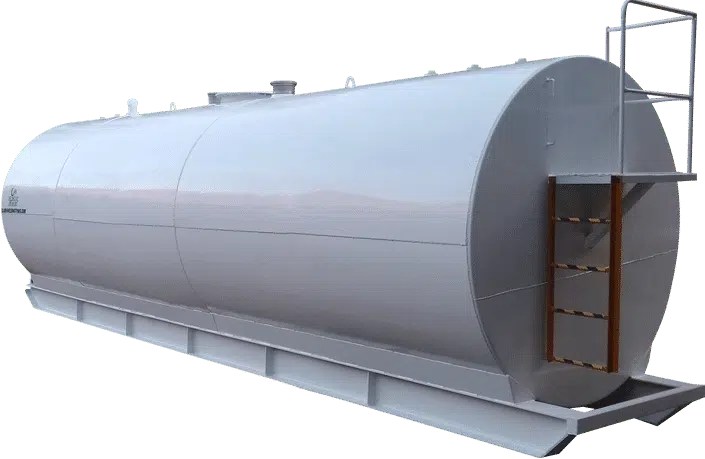
Horizontal tanks are the most popular design for fleet fueling, equipment fueling, and commercial applications because they provide convenient access for pumps, filters, and dispensing equipment.
Vertical Tanks
Many owners choose vertical tanks when available space is limited or when they need a smaller installation footprint.
Single Wall vs. Double Wall Tanks
Buyers may also choose between single wall and double wall construction.
- Single wall tanks are commonly used when facilities provide separate secondary containment.
- Double wall tanks include an interstitial space that provides built-in secondary containment and allows leak monitoring in many applications.
Depending on the application, tanks can also be equipped with:
- Pumps
- Flow meters
- Filtration systems
- Ladders
- Platforms
- Level gauges
- Overfill prevention devices
- Custom nozzle layouts
- Heat tracing
- Insulation
- Pump mounting brackets
- Other custom accessories
Selecting these features during the design stage often creates a system that is easier to install, maintain, and operate.
Questions We'll Ask Before Recommending a UL 142 Tank
Every project is different.
Before recommending a storage tank, we like to understand how the tank will actually be used.
Some of the questions we'll ask include:
- What product will the tank store?
- How many gallons do you need?
- What equipment or vehicles will the tank fuel?
- Where will the tank be installed?
- Have you spoken with your Authority Having Jurisdiction (AHJ)?
- Does the project include an engineer's specification?
- Will the tank require pumps, meters, or dispensing equipment?
- Do you expect your fuel storage needs to grow in the future?
The answers help us recommend the storage solution that best fits your application.
Could Another Tank Be a Better Choice?
Although UL 142 tanks are an excellent solution for many applications, they are not always the only option.
Some projects benefit from an STI Flameshield® tank when additional fire-resistant performance is desired.
Other installations require a UL 2085 Fireguard® tank because of local fire codes, insurance requirements, project specifications, or direction from the Authority Having Jurisdiction (AHJ).
The key is selecting the right tank for the application instead of assuming every project requires the same type of storage tank.
Why Manufacturing Quality Matters
Two tanks may look very similar on paper, yet perform very differently over time.
Material quality and weld integrity matter. So do protective coatings, surface preparation, engineering, manufacturing workmanship, and quality control. Together, they determine how well an above ground storage tank performs over the long term.
Reliable engineering support and responsive customer service are equally important, especially for commercial and industrial projects where specifications are demanding and downtime can be costly.
At Clark Welding Tanks, we work closely with customers to provide storage solutions that meet project requirements while helping simplify installation, operation, and long-term maintenance.
Buy the Right Tank the First Time
Choosing a fuel storage tank involves much more than selecting a gallon capacity.
Start by considering the product you'll store. Then evaluate local code requirements, site conditions, delivery schedules, fueling equipment, future expansion, and long-term maintenance.
The goal isn't to buy the highest specification tank available.
The goal is to choose the storage solution that best fits your application, operating requirements, budget, and applicable codes.
Taking time to answer those questions before placing an order can reduce installation costs, simplify permitting, minimize maintenance, and provide years of dependable service.
A properly specified tank should support your operation from the day it arrives through many years of reliable service.
Still Have Questions?
Every fuel storage project is different, and choosing the right storage tank starts with asking the right questions.
At Clark Welding Tanks, we've spent more than 23 years helping customers select above ground storage tanks for commercial, industrial, agricultural, municipal, and aviation applications. We understand that no two projects are exactly alike, which is why we take the time to learn about your operation before recommending a tank.
Whether you're replacing an existing tank, building a new fueling facility, expanding your fleet, or planning a backup power installation, we'll help you evaluate your options and identify a storage solution that fits your application.
If you're unsure whether a UL 142 tank, STI Flameshield® tank, or UL 2085 Fireguard® tank is the right choice, Contact Clark Welding Tanks. Our team will help you choose a tank that meets your operational needs, project specifications, and applicable code requirements.
The right tank does more than store fuel. It helps improve safety, simplify maintenance, support reliable operations, and provide dependable service for years to come.