Mining Fuel Storage Tanks for Mines and Quarries
A haul truck parked for fuel is not moving material. When equipment waits in line at the fuel station, production slows and operating costs increase. Mining fuel storage tanks help keep haul trucks, excavators, loaders, drills, crushers, generators, and support equipment fueled so crews can stay productive throughout the workday.
A fuel tank is much more than a place to store diesel. It is the center of a fueling operation. Tank capacity, wall construction, fire protection, dispensing equipment, containment, and placement all affect safety, uptime, maintenance, and long-term operating costs. Choosing the right system starts with understanding how your mine or quarry operates.
At Clark Welding Tanks, we work with customers to build fuel storage solutions that match demanding industrial applications. Every mining operation is different, so the best tank is the one designed around your equipment, fueling schedule, and site conditions.
Start With Fuel Demand Instead of Tank Size
The first question should not be, “How many gallons do we need?” Instead, ask how much fuel the operation consumes during a normal day, week, and month.
A tank that appears large enough may still create problems if it requires frequent deliveries or causes equipment to wait in line for fuel. On the other hand, an oversized tank may increase project costs and require more space than the site can support.
Start by listing every piece of equipment that will use the fuel system, including:
- Haul trucks
- Excavators
- Wheel loaders
- Dozers
- Drills
- Crushers
- Conveyors
- Generators
- Water trucks
- Pickup trucks and service vehicles
Estimate the average fuel consumption for each shift. Then consider delivery schedules, weather delays, and emergency reserve capacity. Planning for unexpected events helps reduce downtime when fuel deliveries are delayed.
Mining operations also change over time. New equipment, additional shifts, or expanded production can quickly increase fuel demand. Planning room for future growth today may eliminate the need for expensive changes later.
Think About the Entire Fueling Process
The largest tank is not always the most efficient solution.
The speed of the fueling operation depends on several factors, including:
- Pump flow rate
- Hose length
- Number of dispensing stations
- Traffic patterns
- Nozzle selection
- Equipment access
If every haul truck must wait behind another truck to refuel, production suffers regardless of tank size.
Some mining operations work well with one central fueling location. Others benefit from combining a bulk storage tank with a mobile fueling unit that brings fuel closer to active work areas. Reducing travel time can save valuable production hours over the course of a year.
Choose the Right Mining Fuel Storage Tank
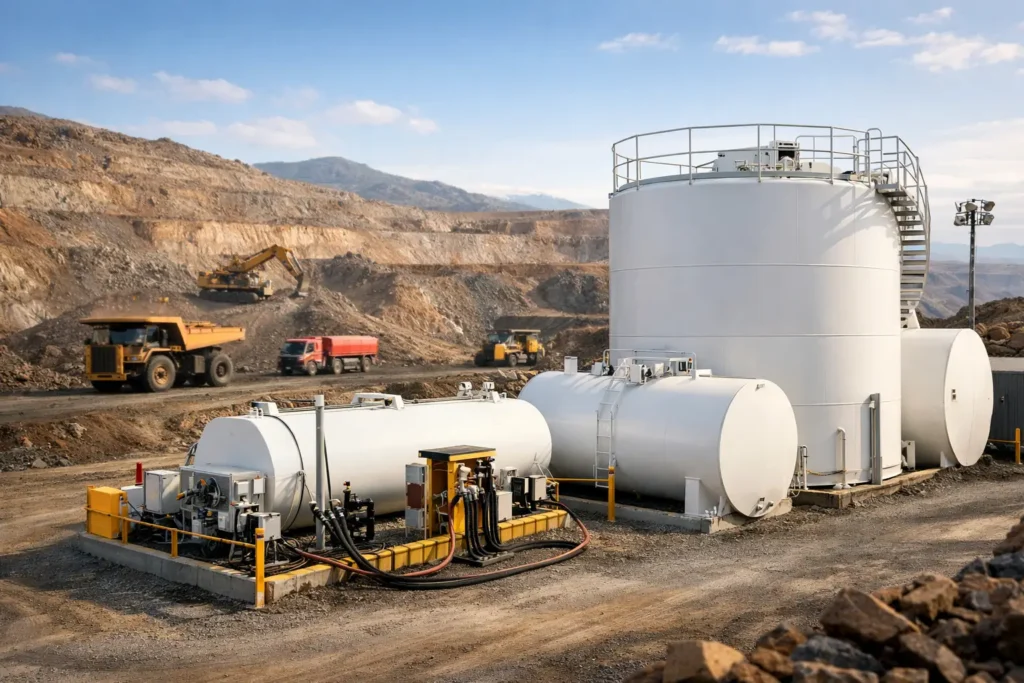
Steel aboveground tanks remain the preferred choice for many mines and quarries because they provide durability, easy inspection, and flexible equipment options. The best construction depends on site conditions, local requirements, insurance guidelines, and operational goals.
A UL 142 above ground storage tank is a common choice for storing diesel fuel. Single-wall models may be appropriate where a properly designed external containment system is provided and local regulations allow their use.
Many mining operations choose double-wall tanks because they provide integral secondary containment within the tank itself. This design simplifies installation while reducing the need for separate containment structures. Double-wall tanks also create a cleaner and more organized fueling area.
When additional fire protection is needed, an STI Flameshield® tank provides a double-wall design with a fire-protective interstitial space. For sites requiring a higher level of protection, a UL 2085 Fireguard® tank offers insulated secondary containment and enhanced fire resistance. These systems are often selected for locations near buildings, maintenance shops, property lines, or other sensitive areas.
No matter which tank you choose, proper placement is just as important as tank construction. Local fire officials, environmental agencies, insurance providers, and the authority having jurisdiction may all influence the final installation.
Mining Sites Present Unique Challenges
Unlike many commercial fueling locations, mines and quarries operate in demanding environments.
Fuel systems often face:
- Heavy dust
- Continuous vibration
- Rough terrain
- Remote locations
- Long operating hours
- Extreme heat and cold
- Heavy equipment traffic
These conditions affect more than the tank itself. Pumps, hoses, meters, valves, and electrical equipment should all be selected with the environment in mind.
A properly designed fueling system helps protect equipment, improve reliability, and reduce maintenance throughout the life of the installation.
Design the Fueling Area for Daily Operations
Even the best mining fuel storage tanks can create problems if the fueling area is poorly planned. Equipment should move through the fueling station safely and efficiently without interfering with production.
Think about how fuel delivery trucks will access the site. Leave enough room for turning, unloading, and future maintenance. Operators should be able to fuel equipment without blocking traffic or creating unnecessary congestion.
The tank foundation is just as important as the tank itself. A properly prepared foundation supports the full weight of the tank when it is full of fuel and helps maintain long-term stability. The area should also provide good drainage so standing water does not collect around the tank or weaken the base over time.
Many mining operations also install barriers to protect the fueling system from accidental impacts. Bollards, guardrails, or other protective barriers can help prevent damage from haul trucks, loaders, and service vehicles working nearby.
Good lighting is another important safety feature. Crews often fuel equipment before sunrise, after sunset, or during poor weather. Proper lighting helps operators read meters, inspect equipment, identify spills, and work safely around hoses and dispensing equipment.
Protect Fuel Quality
Clean fuel protects expensive equipment.
Water, dirt, and other contaminants can damage injectors, plug filters, reduce engine performance, and increase maintenance costs. A single contaminated tank can affect an entire fleet.
A quality fuel storage system should include equipment designed to help maintain fuel quality, such as:
- Fuel filtration
- Water management
- Proper tank vents
- Overfill protection
- Quality dispensing equipment
- Secure fill connections
Modern diesel engines use high-pressure fuel systems with tight tolerances. Clean fuel is more important today than ever before.
Routine inspections are equally important. Operators should regularly inspect hoses, nozzles, vents, gauges, fittings, and containment areas for signs of wear or damage. Removing water from stored fuel when needed also helps extend equipment life.
Build Safety Into the System
Safety should be part of every fueling operation from the beginning.
Depending on the application, mining fuel storage tanks can be equipped with features that improve operator safety and help support site-specific safety programs.
Common options include:
- Emergency shutoff systems
- Lockable fill caps
- Lockable pump cabinets
- Anti-slip stairs and platforms
- Safety handrails
- High-visibility safety markings
- Protected pump enclosures
- Hose reels
- Spill containment accessories
Many mining customers also request equipment that helps support MSHA safety requirements. While every mine has its own standards and operating procedures, Clark Welding Tanks can incorporate safety features commonly specified for mining environments to help customers meet their operational needs.
Plan for Environmental Compliance
Fuel storage regulations vary by state and by facility.
Many mining operations should evaluate whether the EPA 40 CFR Part 112 Spill Prevention, Control, and Countermeasure (SPCC) rule applies to their site. Facilities that exceed certain oil storage thresholds and could reasonably discharge oil into navigable waters or adjoining shorelines may be required to maintain an SPCC Plan.
Local fire codes also play an important role. NFPA 30 provides requirements for the storage and handling of flammable and combustible liquids, while local authorities determine how those requirements apply to individual installations.
Planning for compliance before construction begins is usually far easier than modifying a completed installation later.
Consider Standard and Custom Tank Solutions
Many mining operations can use a standard fuel storage tank. Others require a custom solution designed around the site.
Every mine has different challenges. Limited space, uneven terrain, unique equipment layouts, or high fuel demand may require modifications that improve efficiency and simplify daily fueling.
Custom options may include:
- Split-compartment tanks for multiple fuels
- Custom pump packages
- High-flow dispensing systems
- Fuel management systems
- Hose reels
- Equipment platforms
- Stairways and handrails
- Lockable equipment cabinets
- Custom connection locations
- Skid-mounted fuel systems
The goal is not to add unnecessary features. Instead, every option should solve a specific operational challenge while making the fueling system safer and easier to use.
Plan for Future Growth
Mining operations rarely stay the same for long.
A quarry may add another crusher. A mine may expand into a new section. Additional haul trucks and loaders often increase fuel demand long before the original fueling system reaches the end of its service life.
Planning for future growth can save both time and money. Leave enough room for another tank, additional dispensing equipment, or a larger delivery area if expansion is likely. A little planning today can prevent expensive site modifications later.
Maintenance Protects Your Investment
Even a well-built fuel storage tank requires regular maintenance.
Routine inspections help identify small problems before they become expensive repairs or cause unplanned downtime.
A maintenance program should include checking:
- Tank exterior
- Coatings and paint
- Hoses and nozzles
- Pumps and meters
- Vents
- Valves
- Gauges
- Leak detection equipment
- Containment areas
- Foundation condition
Fuel quality should also be monitored regularly. Water, sediment, and microbial growth can develop over time, especially when fuel remains in storage for extended periods. Keeping fuel clean helps protect expensive diesel engines and reduces unexpected maintenance costs.
Many facilities also schedule periodic inspections based on manufacturer recommendations and industry standards, such as those published by the Steel Tank Institute (STI).
Work With a Manufacturer That Understands Mining
Mining fuel storage is different from fueling a small commercial fleet.
Mine sites operate in demanding conditions with heavy equipment, long workdays, constant vibration, and challenging weather. The right manufacturer understands those conditions and designs tanks that perform reliably year after year.
At Clark Welding Tanks, we work with customers to understand their application before recommending a solution. That includes discussing fuel type, storage capacity, site layout, dispensing equipment, safety features, and future expansion plans.
Whether you need a standard UL 142 above ground storage tank or a custom-built fueling system designed for a demanding mining environment, our goal is the same: provide dependable equipment that supports safe and efficient operations.
Invest in a Fueling System That Supports Production
The right mining fuel storage tanks do more than hold fuel. They help keep equipment operating, reduce unnecessary downtime, improve safety, and support long-term productivity.
Choosing the right capacity, tank construction, dispensing equipment, and safety features creates a fueling system that works with your operation instead of slowing it down. Whether your site serves a small quarry or a large mining operation, careful planning today can improve efficiency for years to come.
Working with an experienced manufacturer also helps ensure the finished system matches your operating needs. From standard storage tanks to fully customized fueling solutions, selecting the right equipment is an investment in productivity, safety, and reliability.
If you’re planning a new mining fuel system or expanding an existing operation, Contact Clark Welding Tanks. Our team can help you choose the right tank, accessories, and configuration for your application.
Frequently Asked Questions
What size mining fuel storage tank do I need?
The right size depends on your equipment fleet, daily fuel consumption, delivery schedule, and desired fuel reserve. Many operations also plan for future expansion when selecting tank capacity.
Are double-wall tanks better for mining applications?
Double-wall tanks provide built-in secondary containment, making them a popular choice for many mining and quarry operations. The best option depends on your site conditions, local regulations, and operational requirements.
Can mining fuel storage tanks be customized?
Yes. Many operations choose custom features such as split compartments, high-flow pumps, equipment platforms, stairs, handrails, lockable cabinets, fuel management systems, and specialized dispensing equipment.
Do mining fuel storage tanks have to meet environmental regulations?
Many installations are subject to federal, state, and local requirements. Depending on the facility, this may include EPA 40 CFR Part 112, local fire codes, and other regulations. Always verify the requirements that apply to your specific site before installation.
Can Clark Welding Tanks build tanks with mining safety features?
Yes. We can build tanks with many of the safety features commonly requested for mining operations, including anti-slip access, safety rails, protected pump enclosures, lockable equipment, emergency shutoffs, and other options that help support site safety programs and MSHA requirements.