Understanding Fuel Tank Codes and Standards
Choosing the right fuel tank involves more than selecting a size and requesting a price. The fuel you plan to store, where the tank will be installed, and how it will be used all affect which codes and standards apply.
A tank that works well for one project may not be the right choice for another. A farm diesel tank has different requirements than a fleet fueling system, an emergency generator fuel tank, or a gasoline dispensing installation. Understanding those differences early can help prevent costly changes, permit delays, and installation problems later.
This guide explains the fuel tank codes and standards commonly associated with above ground fuel storage so you can make informed decisions before ordering a tank.
Understanding the Difference Between Codes and Standards
Before looking at specific requirements, it helps to understand a few common terms.
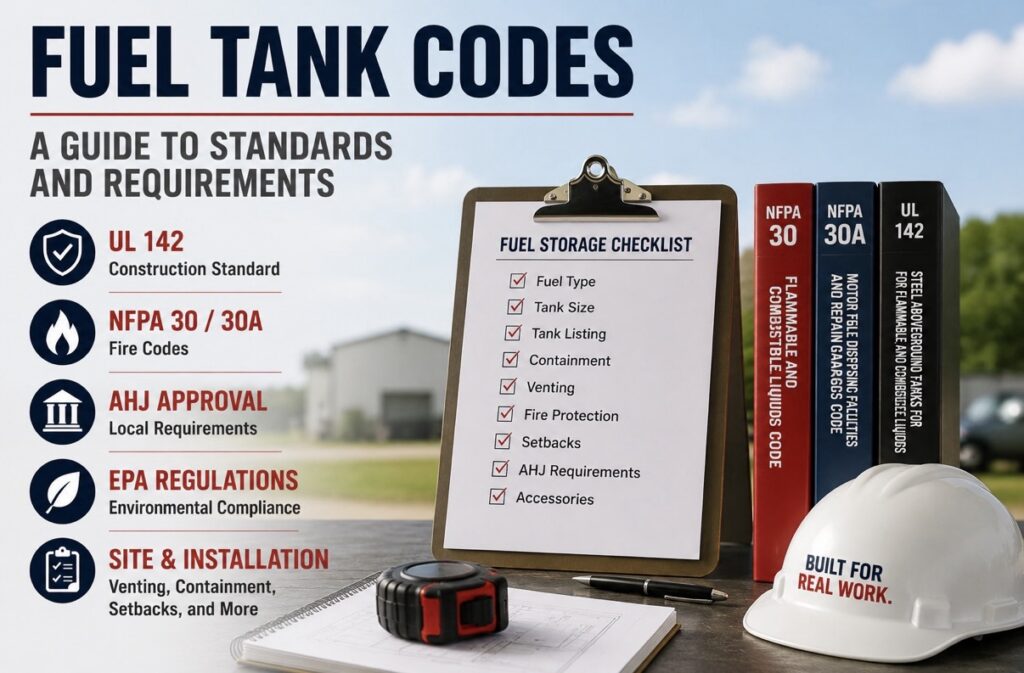
A standard explains how a product should be designed, manufactured, tested, or evaluated. For example, UL 142 is a nationally recognized construction standard for certain above ground steel storage tanks.
A code establishes rules for how equipment should be installed and used. Fire codes often address tank location, venting, emergency controls, setbacks, dispensing equipment, and fire protection.
A code does not automatically become law. It generally becomes legally enforceable only after it is adopted by a state, county, city, or another Authority Having Jurisdiction (AHJ). That’s one reason fuel storage requirements can vary from one location to another.
The important thing to remember is that a tank may meet a recognized construction standard while still needing to comply with adopted fire codes, environmental regulations, insurance requirements, and project specifications before it can be installed.
Start With the Application
Every fuel storage project starts with one simple question: What does the tank need to do?
A diesel tank supplying an emergency generator has different design considerations than a fleet fueling tank, a farm diesel tank, or a commercial gasoline dispensing system. Fuel type matters. Capacity matters. Dispensing equipment matters. The tank’s location and the surrounding property matter too.
Start by answering a few basic questions:
- Will the tank store diesel, gasoline, heating oil, waste oil, or another liquid?
- Will fuel be dispensed from the tank?
- Is secondary containment required?
- Will the tank be installed indoors or outdoors?
- Is the installation close to buildings, property lines, or public access areas?
- Does the project require enhanced fire protection?
The answers help determine whether your project is better suited for a UL 142 above ground storage tank, an STI Flameshield® tank, a UL 2085 Fireguard® tank, or another storage solution.
If you’re still comparing tank styles, our guide on Choosing the right above ground fuel storage tank is another helpful resource before making a final decision.
Understanding UL 142 Tanks
For many above ground fuel storage projects, UL 142 is the starting point.
UL 142 is a nationally recognized construction standard for steel above ground tanks used to store flammable and combustible liquids. These tanks are available in horizontal and vertical designs, as well as single-wall and double-wall configurations.
A single-wall tank has one steel shell and may be appropriate when separate secondary containment is provided or when local requirements allow it.
A double-wall tank surrounds the primary tank with a second steel wall, creating an interstitial space that provides built-in secondary containment. For many farms, construction companies, fleet operations, municipalities, and industrial facilities, this design offers a practical combination of environmental protection and long-term durability.
If you’d like to learn more, visit our UL 142 fuel storage tanks guide or explore our UL 142 above ground storage tanks.
When STI Flameshield® Tanks Make Sense
Some projects require more fire resistance than a standard double-wall tank provides.
An STI Flameshield® tank is a double-wall above ground storage tank with a fire-resistant interstice. It is often selected when owners want additional fire protection while still maintaining integral secondary containment.
Flameshield® tanks are commonly used for commercial, industrial, municipal, and fleet fueling applications where added fire resistance is beneficial.
However, it’s important to remember that a Flameshield® tank is not the same as a UL 2085 protected tank. If a project specification, the AHJ, or the owner’s requirements call for UL 2085 protection, a Flameshield® tank may not satisfy those requirements.
If you’re comparing the different protected tank options, our Flameshield® tank buyer’s guide explains where these tanks are commonly used and what advantages they offer.
Understanding UL 2085 Fireguard® Tanks
Some facilities need a higher level of protection because of limited space, nearby buildings, valuable equipment, or critical operations.
That’s where UL 2085 Fireguard® tanks are often considered.
UL 2085 applies to protected above ground storage tanks that have been tested for enhanced fire resistance and physical protection. These tanks are frequently used at hospitals, data centers, utilities, telecommunications facilities, airports, and other locations where maintaining a dependable fuel supply is especially important.
Protected tanks generally cost more than conventional tanks, but they can provide important benefits when site conditions or project requirements justify the additional protection.
For a more detailed comparison, read our Fireguard® tank buyer’s guide or our article on UL 142 vs. UL 2085 Tanks.
Installation Requirements Matter Just as Much as the Tank
Choosing the right tank is only part of the project. The installation plays an equally important role.
Even if a tank meets the required construction standard, the installation must still comply with the codes and requirements that apply to the site. That’s why it’s important to involve the project team, the Authority Having Jurisdiction (AHJ), and other stakeholders early in the planning process.
Several site conditions can influence the final tank selection, including:
- Distance from buildings and property lines
- Available space
- Vehicle traffic
- Dispensing equipment
- Secondary containment requirements
- Fire protection requirements
- Environmental considerations
- Access for fuel deliveries and maintenance
Addressing these items early helps avoid unexpected changes after the tank has been ordered.
Don’t Overlook Venting and Accessories
Accessories are just as important as the tank itself.
Every above ground fuel tank requires properly sized venting. Most installations include both a normal vent and an emergency vent. The required vent size depends on factors such as tank capacity, fuel type, fill rate, and the codes that apply to the installation.
Many fuel systems also include:
- Overfill prevention equipment
- Spill containers
- Leak detection
- Pumps
- Filters
- Meters
- Fuel dispensers
- Tank gauges
- Emergency shutoff equipment
- Hose reels
- Nozzle holders
Selecting these components during the planning stage helps ensure the entire fuel storage system works together safely and efficiently.
If you’re planning a complete fueling system, explore our tank options and accessories to see the equipment available for above ground storage tanks.
Work With the AHJ Early
One of the smartest things you can do is involve the Authority Having Jurisdiction (AHJ) early in your project.
The AHJ is responsible for enforcing the codes that apply in your area. Because different states, counties, and cities may adopt different editions of the fire code, requirements can vary from one project to another.
It’s also common for insurance carriers, facility owners, engineers, or project specifications to include additional requirements beyond the adopted code.
Confirming these requirements before ordering a tank can prevent delays, change orders, and unnecessary expenses later. A few conversations during the planning stage often save significant time and money once construction begins.
Industry resources such as NFPA 30, NFPA 30A, EPA 40 CFR Part 112, and the Steel Tank Institute (STI) also provide valuable guidance for above ground fuel storage projects.
Choosing the Right Fuel Tank
The best fuel storage projects begin with good information.
Instead of focusing on one code or one tank style, look at the entire application. Consider the fuel being stored, the required capacity, available space, dispensing equipment, fire protection needs, and the codes that apply where the tank will be installed.
If the required listing hasn’t been determined yet, don’t guess. Share as much information as possible with your tank manufacturer, including:
- Fuel type
- Desired capacity
- Tank location
- Whether fuel will be dispensed
- Site drawings, if available
- Known project specifications
- Local AHJ requirements
- Insurance or owner requirements
The more information you provide, the easier it is to recommend the right tank before fabrication begins.
Clark Welding Tanks Can Help
At Clark Welding Tanks, we help customers select fuel storage systems that match their application, site conditions, and project requirements.
Whether you need a UL 142 above ground storage tank, an STI Flameshield® tank, a UL 2085 Fireguard® tank, or another above ground storage solution, our team can help you understand your options before you place an order.
We’ll help you evaluate capacity, containment, fire protection, dispensing equipment, accessories, and the applicable standards so you can make an informed decision with confidence.
If you’re ready to discuss your project, contact Clark Welding Tanks or request a fuel storage tank quote today.