Choosing the Right Above Ground Storage Tank
Choosing the right above ground storage tank is one of the most important decisions you'll make before purchasing a fuel storage system. Before you compare tank types, take a moment to understand your site, local requirements, and how the tank will be used.
The correct tank depends on your application, site layout, local fire codes, environmental regulations, and the requirements of the Authority Having Jurisdiction (AHJ). In most cases, the AHJ is your local Fire Marshal, building official, or environmental agency responsible for approving the installation.
Because local requirements can vary, it's always important to verify which tank type is acceptable before placing an order.
This article is for informational purposes only. Always consult your local AHJ and applicable codes before purchasing or installing an above ground storage tank.
The Three Main Types of Above Ground Storage Tanks
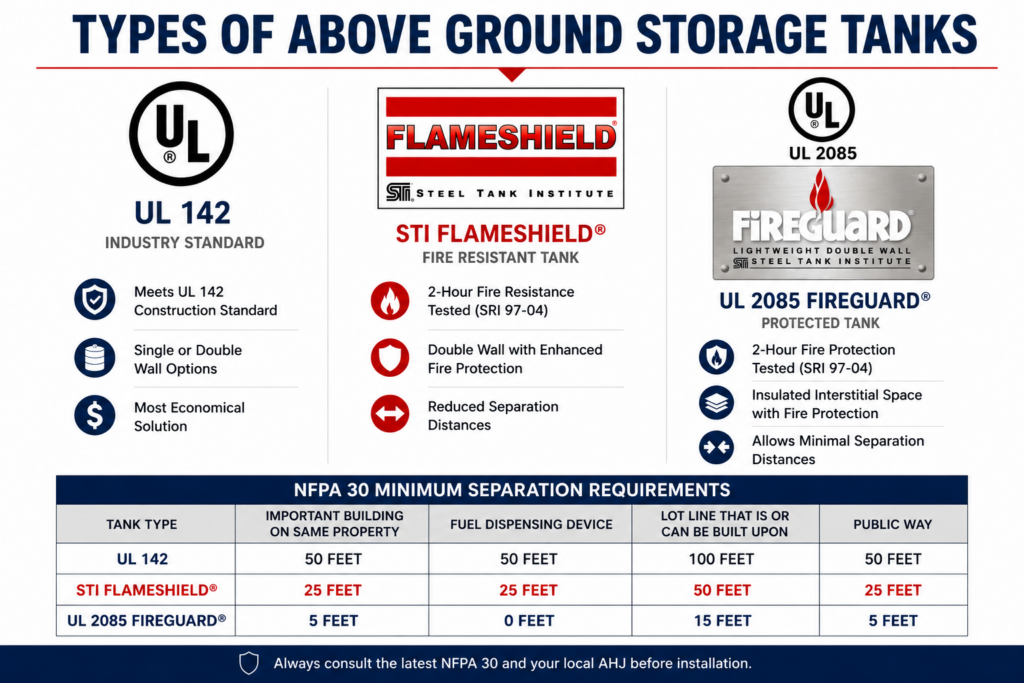
Most commercial above ground fuel storage tank manufacturers offer three primary tank classifications:
Although all three are designed to safely store fuel above ground, each offers a different level of fire protection and installation flexibility. Understanding these differences can help you select the right tank before your project begins.
UL 142 Above Ground Storage Tanks
A UL 142 above ground storage tank is the industry standard for storing flammable and combustible liquids above ground. These tanks are available in both single wall and double wall designs, with double wall models providing built-in secondary containment.
For many facilities, a UL 142 tank is the most economical choice when the site has enough room to meet local setback requirements. As a result, these tanks remain the most common option for commercial and industrial fuel storage.
Benefits
- Most economical option
- Available in single wall and double wall designs
- Ideal when adequate separation distances are available
- Widely used for commercial, agricultural, industrial, fleet, and construction fueling
STI Flameshield® Tanks
A Flameshield® tank is built to the UL 142 standard while incorporating Steel Tank Institute (STI) Flameshield® technology. These double wall tanks successfully complete a two-hour fire resistance test using Southwest Research Institute Standard 97-04.
As a result, many Fire Marshals accept a Flameshield® tank where a standard UL 142 tank may not meet local requirements. In addition, its fire-resistant construction often qualifies for reduced separation distances under NFPA 30.
Learn more about Flameshield® trademark information.
Benefits
- Two-hour fire-resistant design
- Double wall secondary containment
- Reduced separation distances
- Lower cost than many protected tank systems
UL 2085 Fireguard® Tanks
A UL 2085 Fireguard® tank provides the highest level of fire protection among these three tank types. Unlike a standard double wall tank, the interstitial space contains lightweight insulating material that provides both thermal protection and fire resistance.
In addition, Fireguard® tanks carry Steel Tank Institute (STI) Fireguard® certification and exceed the same two-hour, 2,000°F fire exposure testing requirements.
Consequently, Fireguard® tanks often qualify for the shortest separation distances under NFPA 30. This makes them an excellent solution for facilities where installation space is limited or where local codes require additional protection.
Learn more about Fireguard® trademark information.
Benefits
- UL 2085 listed construction
- Built-in lightweight fire insulation
- Excellent thermal protection
- Shortest separation distances of the three tank types
- Ideal for commercial, municipal, and high-risk installations
Understanding Separation Requirements
Another important consideration is the minimum separation distance required by NFPA 30 when enforced by the local AHJ.
Generally speaking:
- UL 142 tanks require the greatest separation distances.
- STI Flameshield® tanks often qualify for reduced setbacks because of their fire-resistant construction.
- UL 2085 Fireguard® tanks typically allow the smallest separation distances because they are classified as protected aboveground tanks.
For that reason, reduced setbacks often become the deciding factor when selecting a tank for sites with limited space or nearby buildings.
Always verify current separation requirements with your local Fire Marshal or Authority Having Jurisdiction before purchasing a tank, since local codes and editions of NFPA 30 may vary.
Which Above Ground Storage Tank Is Right for You?
Ultimately, every installation is different.
For example, if your site has plenty of available space, a UL 142 above ground storage tank is often the most cost-effective solution.
However, if your project requires additional fire protection or reduced setbacks, an STI Flameshield® tank may be the better choice.
Finally, when maximum fire protection and the smallest installation footprint are priorities, a UL 2085 Fireguard® tank is typically the preferred solution.
Depending on the fuel being stored, additional environmental regulations such as EPA 40 CFR Part 112 may also apply.
Working with an experienced manufacturer early in your project helps ensure you select the right tank while meeting local codes, operational requirements, and long-term safety goals.
Clark Welding Tanks
At Clark Welding Tanks, we manufacture above ground steel storage tanks for commercial, industrial, agricultural, municipal, construction, and fleet fueling applications.
No matter which tank type best fits your project, our experienced team can help you select the right solution based on your application, local requirements, and operational needs.
Ready to get started? Contact Clark Welding Tanks today to discuss your fuel storage needs.