Understanding SPCC Tank Requirements Before You Install a Fuel Storage Tank
A new diesel tank can solve storage and fueling problems, but it also creates long-term responsibilities. If your facility stores oil and a spill could reach a creek, ditch, storm drain, or other waterway, you need to understand EPA 40 CFR Part 112 before you install the tank.
SPCC stands for Spill Prevention, Control, and Countermeasure. The Environmental Protection Agency (EPA) created these regulations to help facilities prevent oil spills from reaching navigable waters and adjoining shorelines. The rules also require facilities to prepare for a spill so they can respond quickly if one occurs.
For most businesses, SPCC compliance is much more than filling out paperwork. It influences the type of tank you purchase, where you install it, how you manage deliveries, what kind of containment you need, how you inspect equipment, and how you train employees. Planning for compliance before construction usually costs far less than making changes after a tank is already in service.
If you are still comparing tank options, our guide to Choosing the right above ground fuel storage tank explains many of the design decisions that should happen before installation.
Determine Whether SPCC Applies to Your Facility
Many facilities first ask one simple question: “Do these rules apply to me?”
In general, an SPCC Plan may be required if a non-transportation-related facility stores more than 1,320 gallons of aggregate aboveground oil storage capacity or more than 42,000 gallons of completely buried oil storage capacity, and a spill could reasonably reach navigable waters or adjoining shorelines.
One of the biggest surprises for facility owners is how broadly the EPA defines “oil.” The rule covers much more than diesel fuel or gasoline. It also includes:
- Diesel fuel
- Gasoline
- Heating oil
- Hydraulic oil
- Lubricating oil
- Waste oil
- Vegetable oils
- Animal fats
- Many other oil-based products
Your property does not have to border a river or lake for SPCC to apply. Oil can travel much farther than many people realize. A spill may move through roadside ditches, drainage swales, culverts, storm drains, or natural drainage channels before reaching protected waters.
Another common misunderstanding involves storage capacity. SPCC uses the maximum capacity of each container, not the amount normally stored inside it. For example, a 2,000-gallon tank counts as 2,000 gallons even if you normally keep only 700 gallons of fuel in it.
Because some containers qualify for exclusions, avoid estimating your total storage capacity. Instead, build a complete inventory of every oil-containing container on the property.
Your inventory should include:
- Fuel storage tanks
- Generator day tanks
- Waste oil tanks
- Drums and totes
- Hydraulic reservoirs
- Transformers containing oil
- Portable fuel tanks
Record each container’s capacity, contents, and location. This simple exercise often answers whether SPCC likely applies and provides the foundation for the rest of your compliance planning.
If your facility is expanding or adding storage, now is also a good time to evaluate whether a standard UL 142 above ground storage tank or another tank design better fits your application.
Build an SPCC Plan Around Your Actual Facility
If your site falls under the SPCC rule, you need a written SPCC Plan that reflects how your facility actually operates. Avoid generic templates that describe an imaginary facility. Your plan should match your equipment, your employees, your fueling procedures, and your site’s drainage patterns.
Most SPCC Plans require certification by a licensed Professional Engineer. However, some smaller facilities may qualify to self-certify under the EPA’s Tier I or Tier II provisions. Eligibility depends on factors such as total oil storage capacity, spill history, and the specific requirements outlined by the EPA.
An effective SPCC Plan should identify each storage system and explain how the facility prevents, controls, and responds to spills. Typical topics include:
- Tank construction and capacity
- Secondary containment
- Overfill prevention
- Fuel delivery procedures
- Inspection schedules
- Employee training
- Spill response equipment
- Drainage controls
- Emergency contacts
- Reporting procedures
A site map should also be part of the plan. It should clearly show tank locations, containment areas, fuel transfer points, stormwater flow, nearby drainage routes, buildings, and spill response equipment. During an emergency, that information becomes extremely valuable.
Remember that an SPCC Plan is not a one-time document. Review it at least every five years, and update it whenever your facility changes in a way that could affect spill prevention or response. Adding another tank, relocating a fueling station, changing drainage patterns, or switching fuel products can all require revisions.
Understand That SPCC Is Only Part of the Project
Many people assume that meeting SPCC automatically means the installation satisfies every regulation. It does not.
SPCC focuses on environmental protection. Your project may also need to comply with local fire codes, building codes, zoning requirements, electrical codes, stormwater regulations, insurance requirements, and state environmental rules.
Those requirements often influence which tank you should purchase.
For many installations, a UL 142 fuel storage tank provides an excellent solution for aboveground petroleum storage. Other locations may require additional fire protection because of property lines, nearby buildings, or local code requirements.
In those situations, a Fireguard® tank buyer’s guide or Flameshield® tank buyer’s guide can help explain the differences between protected tank designs and when they are commonly specified.
It is important to remember that installing a listed tank alone does not make an entire facility SPCC compliant. Compliance depends on the complete system, including containment, piping, overfill protection, operating procedures, inspections, and employee training.
Before placing an order, coordinate with everyone involved in the project, including:
- The local fire marshal
- Building officials
- Environmental agencies
- Your insurance carrier
- The project engineer
- Your tank manufacturer
Confirming requirements early helps prevent expensive surprises later. Something as simple as moving a tank a few feet or selecting a different model can affect setbacks, containment requirements, delivery access, bollard placement, emergency shutoffs, and future maintenance.
Taking time to answer those questions during the planning stage almost always costs less than redesigning an installation after construction begins.
Design Secondary Containment for the Worst-Case Spill
Secondary containment is one of the most important parts of SPCC compliance. Its job is simple: if the primary tank leaks or fails, the released oil must stay contained instead of reaching the environment.
For most bulk storage containers, the containment system must be able to hold the entire capacity of the largest tank in the area, plus enough extra space to account for rainfall. It also needs to remain sufficiently impervious to hold the oil until cleanup crews can remove it.
Several containment options are commonly used, including:
- Double-wall tanks
- Concrete containment walls
- Steel dikes
- Lined earthen berms
- Engineered containment basins
The right solution depends on your site. Tank size, available space, vehicle traffic, weather, maintenance practices, and local code requirements all influence the best choice.
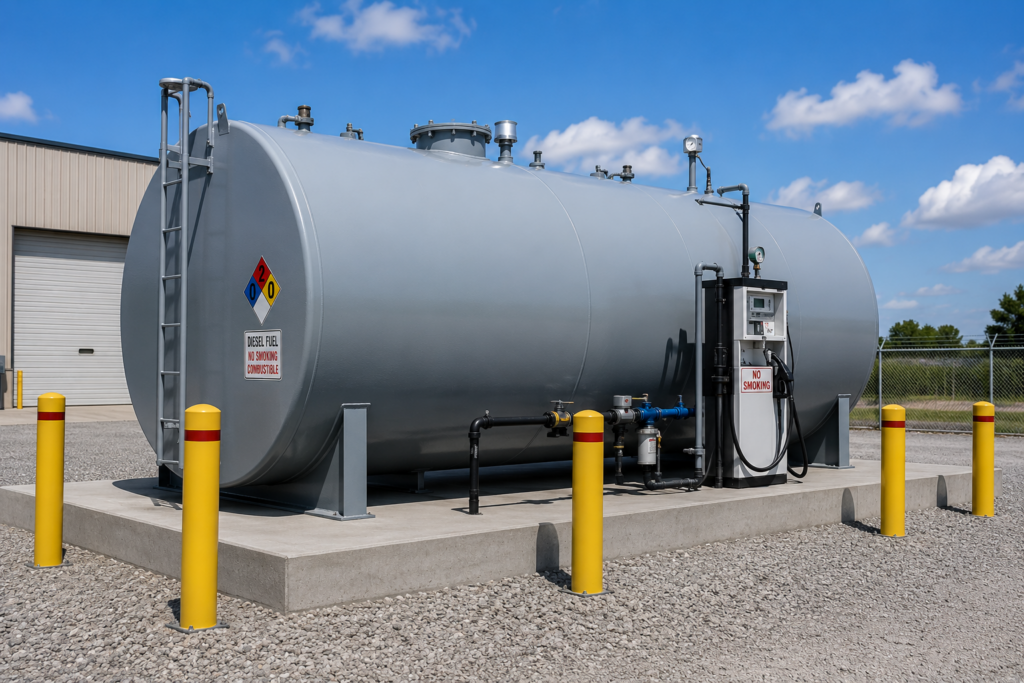
Many facilities choose a UL 142 above ground storage tank with double-wall construction because it provides built-in secondary containment. Even so, do not focus only on the tank itself. Pumps, filters, valves, hoses, piping, fill connections, and dispensing equipment can also leak and should be included in your overall spill prevention strategy.
Double-wall tanks also require regular monitoring of the interstitial space between the inner and outer walls. Make sure employees can easily access monitoring points and understand how to identify potential problems before they become leaks.
Rainwater management deserves attention as well. Containment areas should never become permanent ponds. If rainwater collects inside a dike or containment basin, employees should inspect the water before draining it. Water showing any visible oil sheen should never be discharged. Your SPCC Plan should clearly explain who performs these inspections, how they document them, and what steps they follow before draining accumulated water.
Choose Equipment That Makes Compliance Easier
The easiest system to maintain is one that was designed correctly from the beginning.
Choose a tank that matches the fuel being stored, the expected operating conditions, and the way your facility actually uses fuel. Tank orientation, coatings, fittings, supports, access openings, and inspection points all affect long-term maintenance.
Many facilities begin with a UL 142 tank because it offers a proven design for aboveground petroleum storage. Some projects require additional fire protection, making a Fireguard® tank or STI Flameshield® tank a better fit depending on local code requirements and site conditions.
Overfill protection deserves just as much attention as secondary containment. A spill during fuel delivery can create serious environmental and cleanup costs even when the tank itself remains undamaged.
Depending on the application, overfill protection may include:
- High-level alarms
- Automatic shutoff devices
- Flow restriction devices
- Clearly visible level gauges
- Written fuel delivery procedures
- An employee monitoring deliveries
Protect the tank from vehicle damage whenever traffic operates nearby. Bollards, guardrails, concrete barriers, or thoughtful placement can prevent costly accidents.
The foundation also matters. A properly engineered foundation supports the full weight of a loaded tank while reducing settling, piping stress, standing water, and uneven loading over time.
When purchasing a complete fueling system, many owners find it easier to specify the tank, pump, meter, filtration equipment, containment, and accessories as one coordinated package. Doing so helps eliminate compatibility problems and makes installation much smoother.
Perform Regular Inspections and Keep Good Records
Installing the right tank is only the beginning. Long-term SPCC compliance depends on regular inspections, preventive maintenance, and accurate recordkeeping.
Your inspection program should follow the procedures outlined in your SPCC Plan. Routine visual inspections help identify small problems before they become expensive repairs or environmental incidents.
During inspections, look for:
- Leaks or product staining
- Rust and corrosion
- Damaged paint or coatings
- Loose fittings
- Worn hoses
- Damaged piping
- Oil inside containment areas
- Signs of tank settlement
- Vehicle damage
- Blocked vents or spill prevention equipment
The EPA also requires integrity testing and periodic inspections of aboveground bulk storage tanks using recognized industry standards. The appropriate testing method depends on factors such as the tank’s construction, age, condition, service history, and previous corrosion. A visual inspection alone does not replace a documented integrity testing program.
Maintain complete inspection records with your SPCC Plan. Each record should include the inspection date, the tank identification number, observations, corrective actions, test results, and the name of the person who completed the inspection. Good records demonstrate compliance and make it easier to spot maintenance trends before they become major problems.
Train Employees Before a Spill Happens
Even the best-designed fuel storage system depends on the people who operate it.
Employees who receive fuel deliveries, inspect tanks, transfer product, or respond to emergencies should understand the site’s SPCC procedures and know exactly what to do if a spill occurs.
Training should cover:
- Safe fuel transfer procedures
- Common spill causes
- Proper inspection techniques
- Secondary containment practices
- Spill reporting procedures
- Emergency shutdown procedures
- Locations of spill kits and absorbent materials
- Emergency contact information
Most facilities provide SPCC training at least once each year. Short, hands-on training sessions often work better than long classroom presentations. Walk employees through the actual tank area, identify potential spill points, review delivery procedures, and demonstrate how to use spill response equipment.
Practicing these procedures before an emergency helps employees respond confidently when every minute matters.
Plan Ahead for Long-Term Compliance
SPCC compliance is not about checking a box. It is about protecting your employees, your business, nearby property, and the environment while reducing the risk of costly cleanup, fines, and downtime.
Facilities that plan ahead usually experience fewer problems because the tank, containment system, fueling equipment, and operating procedures work together from the start. That approach also makes inspections easier and simplifies future maintenance.
Whether you are installing your first aboveground fuel tank or expanding an existing facility, investing time in planning can save significant time and expense over the life of the system.
If you’re evaluating storage options, Clark Welding Tanks can help you compare tank designs, understand applicable requirements, and choose equipment that fits your operation. To discuss your project, Contact Clark Welding Tanks or Request a fuel storage tank quote today.